GW interferometry-detectors and associated sensitivity
Nowadays, the most widely applied technology to measure gravitational waves is based on the physical principle of light interferometry. In fact, the Laser Interferometer Gravitational-Wave Observatory (LIGO) was historically the first gravitational-wave detector to collect pioneer measurements. A wide post about the gravitational waves as concept and LIGO’s role is reported in 'From atmospheric noise until quantum noise: hunting gravitational waves'.
Nevertheless, interferometry was not the only technology researched within the gravitational-waves framework. The main families of detectors and designs usually developed, related to interferometry and other physical principles, are listed below.
Resonant-mass detectors
The most typical detectors in this family are the Weber Bars [1,2]. Their mechanical principle is based on the resonant vibration induced in a huge metallic piece. In this regard, the resonant metallic bar presents a natural vibration with an associated wave frequency. When a gravitational wave is captured and crosses through the metallic material, the frequencies reach a resonant state, allowing the acoustic signal to be collected and measured [3].
This type of design is mainly affected by Newtonian noise originated by thermal fluctuations in the metal, which can produce signals with higher values than the corresponding gravitational waves. Other important perturbations affecting resonant-mass detectors are those naturally present in terrestrial environments, such as seismic waves, electronic noise in the signal collectors, acoustic noise, and other human activities.
Surface detectors
LIGO and VIRGO are included in this category [4,5]. They are L-shaped, massive interferometers with arms of several kilometers. Regarding their location in the terrestrial environment, these interferometers are especially sensitive to Newtonian noise related to seismic and meteorological perturbations, and local human activity, among others. Hence, even though these interferometers have proven to be highly effective for high-frequency signals, the uncertainty associated with their low-frequency measurements is significantly high.
Subterranean detectors
The KAGRA telescope in Japan is included in this family [6]. Featuring cryogenic mirrors in its design, it is built underground at several hundred meters of depth in order to minimize ambient noise and improve the low-frequency sensitivity of the sensors. Nevertheless, the contribution of various types of Newtonian noise related to seismic activity and terrain density fluctuations is not negligible. Therefore, in this case, improving the measurement quality at low frequencies is still a challenge.
Third generation detectors
The EINSTEIN Telescope and COSMIC Explorer are included in this classification [7,8]. They are considered the most ambitious future projects in gravitational wave measuring technology.
The EINSTEIN Telescope will be triangular, with long arms and several interferometric configurations. The low-frequency sensitivity is expected to be improved compared to previous designs. In turn, the COSMIC Explorer is expected to be a surface detector with an L-shape and arms of several tens of kilometers. Its sensitivity is supposed to be considerably higher than LIGO, VIRGO, the rest of the previous surface detectors, and even the EINSTEIN Telescope. The specification guidelines of the COSMIC Explorer report the comparative sensitivity curves of COSMIC and these previous designs.
All in all, third-generation detectors will possess significantly high measurement sensitivity, which is, paradoxically, a challenge. The importance of small fluctuations in measurement uncertainties, such as Newtonian noise, becomes critical with increasing instrument sensitivity. Hence, correct site selection, and even the installation of noise-monitoring devices, might be crucial.
Spatial detectors
The future LISA project is classified in this family [9], with a design defined as an interferometer comprising several satellites separated by 2.5 million kilometers. This kind of design maximizes the mitigation of Newtonian noise associated with terrestrial perturbations due to its location outside the Earth's environment.
Nevertheless, other spatial variables could increase Newtonian noise, such as solar radiation pressure or solar winds, which could induce electric charges on the satellites' test masses. Furthermore, aspects such as thermal noise, laser stability, or the huge distance between satellites might increase space-related Newtonian noise.
Pulsar Timing Arrays (PTAs)
PTAs are used to detect very low-frequency gravitational waves by measuring the difference between the real and the expected arrival time of radio signals emitted by several observed pulsars. These time discrepancies are assumed to be produced by the interaction of a gravitational wave [10]. This low-frequency detection methodology is negligibly affected by terrestrial Newtonian noise sources, as the pulsar signal detectors are designed to be installed outside of the terrestrial environment. In spite of that, some Newtonian noise should be considered, specifically related to spacecraft irregularities or electronic noise in telescopes and terrestrial clocks.
Figure 1 reports a schematic graphical resume of the reported families, with the corresponding sources of Newtonian noise mainly affecting measurements from each one.
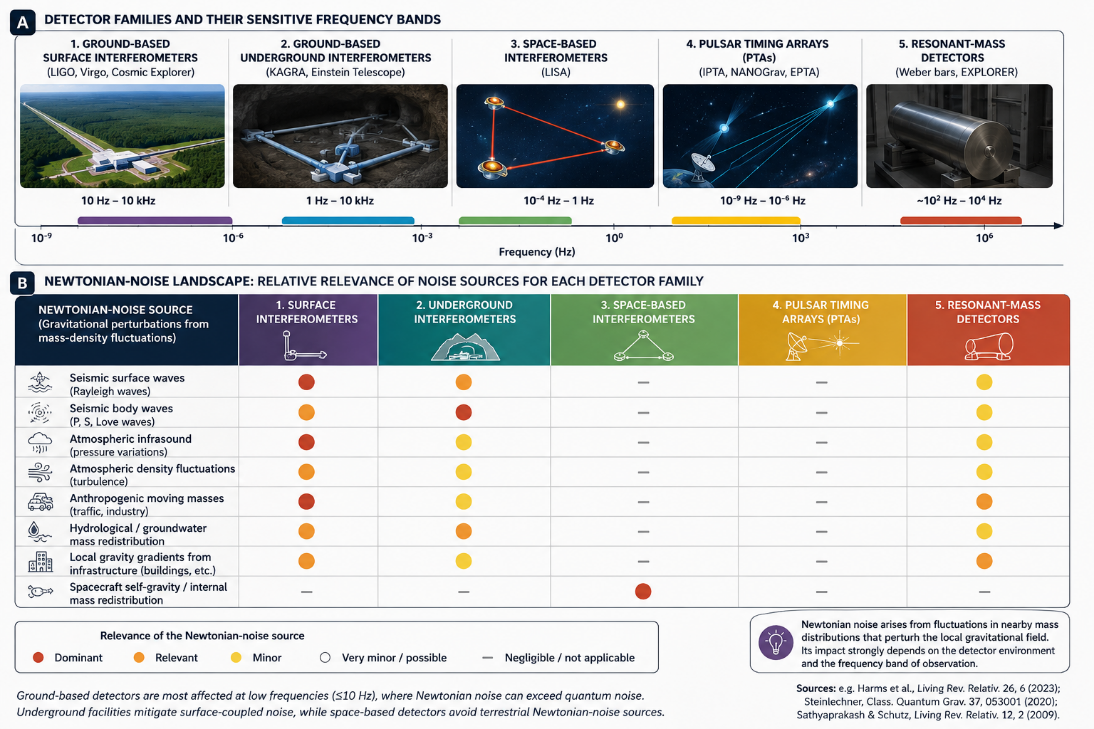
Figure 1. Schematic classification of the diverse gravitational-wave measuring systems, in terms of the detected frequency-ranges and the Newtonian noise sources affecting each type.
Remarks:
Although the improvement in the diverse desings of the gravitational-wave measuting instrumentation, the uncertainty in the measurements related to small environmental perturbations as Newtonian noise is such relevant, especially on low-frequency range. The quantification of the Newtonian noise in terms of its sources supposes the highest challenge to face up with in future detector-design schemes, which results crucial to improve the quality of the gravitational-wave measurements.
References:
[1] J. Weber, «Gravitational-Wave-Detector Events», Phys. Rev. Lett., vol. 20, n.o 23, pp. 1307-1308, jun. 1968, doi: 10.1103/PhysRevLett.20.1307.
[2] J. Weber, «Gravitational Radiation», Phys. Rev. Lett., vol. 18, n.o 13, pp. 498-501, mar. 1967, doi: 10.1103/PhysRevLett.18.498.
[3] O. D. Aguiar, «Past, present and future of the Resonant-Mass gravitational wave detectors», Res. Astron. Astrophys., vol. 11, n.o 1, pp. 1-42, ene. 2011, doi: 10.1088/1674-4527/11/1/001.
[4] The LIGO Scientific Collaboration et al., «Advanced LIGO», Class. Quantum Grav., vol. 32, n.o 7, p. 074001, abr. 2015, doi: 10.1088/0264-9381/32/7/074001.
[5] F. Acernese et al., «Advanced Virgo: a second-generation interferometric gravitational wave detector», Class. Quantum Grav., vol. 32, n.o 2, p. 024001, ene. 2015, doi: 10.1088/0264-9381/32/2/024001.
[6] K. Somiya y for the KAGRA Collaboration, «Detector configuration of KAGRA–the Japanese cryogenic gravitational-wave detector», Class. Quantum Grav., vol. 29, n.o 12, p. 124007, jun. 2012, doi: 10.1088/0264-9381/29/12/124007.
[7] M. Punturo et al., «The Einstein Telescope: a third-generation gravitational wave observatory», Class. Quantum Grav., vol. 27, n.o 19, p. 194002, oct. 2010, doi: 10.1088/0264-9381/27/19/194002.
[8] E. D. Hall, «Cosmic Explorer: A Next-Generation Ground-Based Gravitational-Wave Observatory», Galaxies, vol. 10, n.o 4, p. 90, ago. 2022, doi: 10.3390/galaxies10040090.
[9] M. Armano et al., «Sub-Femto- g Free Fall for Space-Based Gravitational Wave Observatories: LISA Pathfinder Results», Phys. Rev. Lett., vol. 116, n.o 23, p. 231101, jun. 2016, doi: 10.1103/PhysRevLett.116.231101.
[10] G. Hobbs et al., «The International Pulsar Timing Array project: using pulsars as a gravitational wave detector», Class. Quantum Grav., vol. 27, n.o 8, p. 084013, abr. 2010, doi: 10.1088/0264-9381/27/8/084013.

Do you have any questions?
Add new comment